The wind-powered weep vent that keeps working in a storm and helps dry your walls.
Most weep vents stop draining in a storm, when the wind pushes the water back in. This one turns the wind into suction: the harder it blows, the harder it pulls water and damp air out of the wall, while fresh air comes in to help it dry.
- ✓ Keeps draining in a storm
- ✓ Dries the wall, not just drains it
- ✓ Pull-out insert to clear blockages
- ✓ No fan, wiring or running costs
50 vents at £1.80 each, enough for a typical terraced or semi-detached home. Free UK mainland delivery and 14-day returns. Not sure it suits your wall? Call us on 01792 002497.
Two questions to ask any weep vent
Does it still let water out in a storm?
Wind blowing at a standard vent forms a plug, holding water in the wall at the very moment it's pouring in. In our own side-by-side tests, the Active Weep Vent was the only vent that kept letting water out in winds of 20mph and above, and it let out more as the wind rose.
If it blocks, can you clear it?
Insects, mortar and debris block weep vents, and a blocked vent can't let anything out. Clearing a standard one means taking bricks out. This insert pulls out, so you can check it, clear it and put it back.
A bonus most vents can't offer: it dries the wall.
Because it swaps damp cavity air for fresh air right where it's fitted, it doesn't just drain the wall, it helps dry it.
The stronger the wind, the stronger the suction.
It works hardest in a storm, exactly when the cavity needs it most.
- 1
It creates cross-ventilation in the cavity
Fresh air comes in through the top of the vent, exchanges with the moisture-laden air in the cavity, and that damp air is pulled out through the bottom. It all happens at the vent, so nobody has to keep a route clear through the cavity to another façade or section of the building, which can get blocked off later.
- 2
Drier cavity air helps dry the walls
Swapping damp air for fresher air lowers the humidity in the cavity, which gives wet masonry the chance to dry out.
- 3
Water is pulled out, not left behind
Water sitting on a tray, lintel or DPC can evaporate, condense on the inner leaf, wall ties and insulation (interstitial condensation), run back down and start again. The suction is designed to remove it and break that cycle.
- 4
Drier walls can hold heat better
In lab tests, damp insulation let through about 1.9× the heat of dry insulation. We haven't measured savings for the vent itself yet, and walls that are already dry may see no change. Hayrullin et al., 2022
- 5
Less damp on the room side
Cold, damp walls encourage condensation and mould indoors. The vent is designed to help tackle that at the source.
Damp has other sources too, such as leaks and plumbing faults, which a vent can't fix.
Wherever water and damp air get trapped
Because it exchanges air right where it's fitted and pulls water out, it suits the places where water and damp air get trapped:
Walls with rising damp
So far, every rising damp job we've fitted has dried out and stayed dry, with the vents working on their own: no chemicals, no wiring and nothing to drill inside. Monitored trials are under way, and we'll publish the results.
Check your damp symptoms →Cavity trays and chimneys
Wind-driven rain can leave water sitting on a cavity tray until it overflows. The suction is designed to draw that water out, so it isn't left to spill or turn into humidity.
See a real chimney tray case →Lintels over windows and doors
Water collecting above an opening can track into the reveals. Fit at least two over each opening, no more than 450mm apart, as NHBC Standards ask.
Count the vents for your openings →Along the damp-proof course
Fit one every 900mm, the spacing in Approved Document C, to ventilate the base of the wall. The removable insert makes each one quick to inspect and clear.
Compare weep vent types →Existing homes
Each vent goes into a brick perp joint chased out from outside, with no work inside the house, so it suits a retrofit.
See how it's fitted →New build
An inspectable weep vent designed to support Part C and NHBC guidance, from the first course of the build.
Spec pack and samples →Size, fitting and colours
- Size
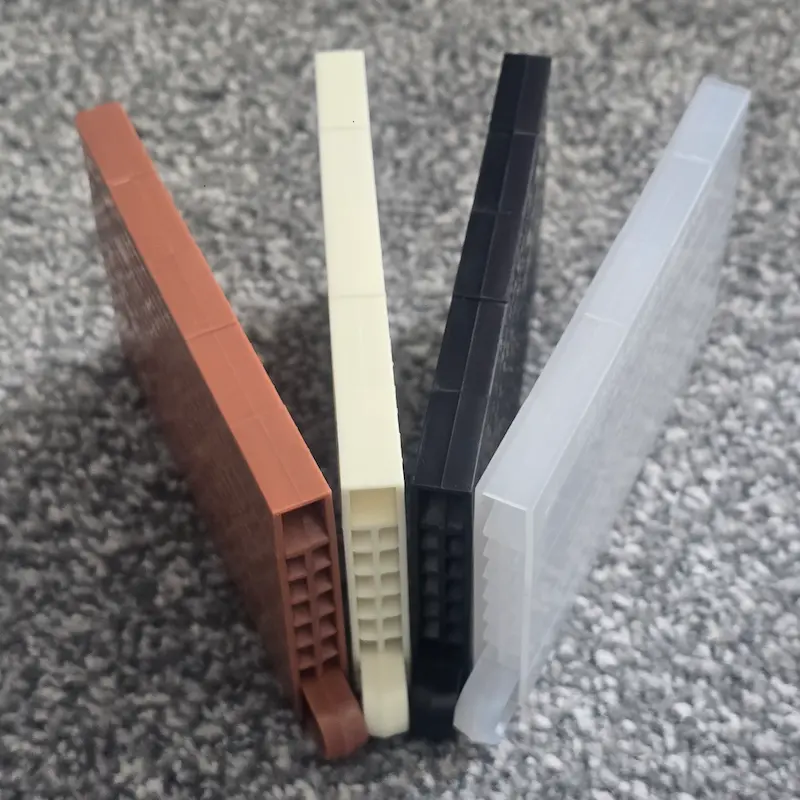
- 10 × 65 × 100mm (W × H × L)
- Fitting
- Fitted in a brick perp joint that has been chased out. Not drilled.
- Colours
- Natural, Grey, Terracotta, Black, Buff, Crystal Clear and Recycled Black (100% recycled polypropylene)
- How many
- About 40 for a typical terraced home, about 50 for a semi-detached home
- Made in
- Manufactured in Cardiff by an ISO 9001-certified manufacturer, and distributed from our base in Swansea
- Patent
- Patent pending
It suits standard render but not external wall insulation or thicker render yet, and it isn't suitable where A1 non-combustible components are required. Ask us if you're unsure.

Shortlisted for the BBA Sustainable Innovator Award
The Active Weep Vent is one of six finalists for the inaugural award, as announced by the BBA on 5 November 2026. The winner will be announced live at London Build, at ExCeL London, on 25 November 2026.
The award recognises innovation in sustainability. Being shortlisted is not a BBA Certificate, and it does not mean a product has been assessed, tested or certified by the BBA. About the award on the BBA website
Before you order
Can I fit them myself?
They're designed to be DIY-friendly. There's no wiring and no work inside the house: chase out the perp joint from outside and fit the vent. Read the installation guide
What happens when there's no wind?
At 0mph it drains like a standard weep vent. As the wind picks up, it starts cross-ventilating the cavity and pulling moisture out, and the harder the wind blows, the harder it pulls.
Will it cure my damp?
No vent can promise that, so find the cause first. The vent is designed to tackle trapped moisture in the wall, but leaks and plumbing faults need fixing at the source. Use the damp solution finder
What if I change my mind?
You're covered by our 14-day returns policy. Read the returns policy
Buying for more than one home?
Further reading
- Series guide The Complete Guide to Cavity Wall Ventilation
Why a cavity wall has to be able to breathe, where the moisture comes from, why damp walls quietly waste heat, and how to keep a cavity dry and drained: a plain-English hub for homeowners, builders and surveyors.
- Awaab's Law Awaab's Law: The Real Costs of Non-Compliance
There is no fixed fine schedule under Awaab's Law. The real consequences, from tenant breach-of-contract claims to Housing Ombudsman and regulator action.
- Awaab's Law Awaab's Law: What the Official Guidance and Ombudsman Say
What GOV.UK guidance, the Housing Ombudsman and the Regulator of Social Housing actually say about damp, mould and Awaab's Law, with links to each source.
Useful pages
- How cross-ventilation works →
Where cavity moisture comes from and why airflow, not sealing, is what keeps a wall dry.
- Benefits →
What the design is built to do, with the published research behind it.
- The evidence →
The independent research behind our approach, with every source linked.
- Weep vent calculator →
How many weep vents your home needs, using Approved Document C and NHBC spacing, and what they cost.
Give the water and damp air a way out
The Whole House Pack of 50 is £90 with free UK mainland delivery, enough for a typical terraced or semi-detached home. Buying for a portfolio or a site? Talk to us.