Find the right fix for damp in your home or building
Answer a few quick questions and get a plan you can act on: the likely cause, whether our vents suit your walls, how many you need, where they go and what they cost. Free, and it takes about two minutes.
- Patent pending
- No electricity to run
- Made in Cardiff by an ISO 9001-certified manufacturer

Who are you?
Pick the one that fits best. You can change it later.
Already know you need weep vents? Go straight to the weep vent calculator.
One small vent that breathes in and out
Ventilation only works when air has a way in and a way out. A vent that only lets air in fills up and stalls; a fan that only pushes air out soon has nothing left to pull. That is why damp so often comes back.
Each Active Vent does both from one unit, powered by the wind. In the wall, the Active Weep Vent draws fresh air in through its upper opening and pulls moist air out through its lower opening, right where it is fitted. At the window, the Active Trickle Vent does the same for the room. Nothing to switch on, and no doors or windows need to be left open.
It is the first vent we know of that uses the wind to move air both in and out of one unit (patent pending), and its removable insert lets you check and clear the cavity behind it at any time.
What you're seeing, and what helps
The same guidance the finder gives, in one place.
Windows streaming with condensation in the morning
Why it happens: Warm, moist air from cooking, washing and breathing has nowhere to go, so it condenses on the coldest surface: the glass.
What helps: Room ventilation needs an inlet and an outlet. The Active Trickle Vent breathes in and out from one unit in the window frame, using the wind, so it does not depend on doors or windows being left open.
How cross-ventilation works ›Black mould in corners or behind furniture
Why it happens: Mould grows where humid air meets a cold surface for long periods. Outside corners and walls behind wardrobes are the coldest and least ventilated spots.
What helps: Tackle both sides of the wall: Active Trickle Vents to move humid air out of rooms, and Active Weep Vents to help the cavity dry so the inner wall is not chilled by a wet outer leaf.
Damp and mould: where it comes from ›Damp patches that appear after heavy rain
Why it happens: Wind-driven rain gets into the cavity through tiny cracks and joints. If it cannot drain and dry, it reaches the inner wall.
What helps: Active Weep Vents use the wind to draw moist air and water out of the cavity. The stronger the wind, the stronger the suction, so they work hardest in a storm. Check gutters, downpipes and pointing as well.
Weep vents compared ›Walls that feel cold or damp to the touch
Why it happens: Wet walls and wet insulation lose heat much faster than dry ones, so the room side of the wall stays cold.
What helps: Active Weep Vents are designed to help the cavity dry out, so the insulation can perform closer to its rated value.
Benefits of a dry cavity ›A tide mark, salts or crumbling plaster low on a wall
Why it happens: These are classic signs of rising damp: ground moisture drawn up into the base of the wall.
What helps: Every rising damp job we have fitted so far has dried out and stayed dry, with the vents doing the work on their own. Fitted at closer centres along the affected wall, they cross-ventilate the base of the wall, drying it out and lowering the humidity in the cavity, with no chemicals and no electricity. Lower humidity matters because it breaks the cycle that keeps walls wet: water sitting on the damp-proof course, a tray or a lintel evaporates, condenses on cold surfaces such as the inner wall, wall ties and insulation, then runs back down and starts again. It is still worth checking for an obvious cause, such as soil or a path built up above the damp-proof course, as clearing it helps the wall dry faster.
Talk to us about rising damp ›Water in the loft, around a chimney or over a window
Why it happens: A cavity tray that cannot drain fills with water and overflows into the building. Driving rain makes it worse.
What helps: Active Weep Vents fitted along the tray give the water a way out and keep drawing it out as the wind rises. Add the tray length in the calculator.
Installation and spacing ›Weep vents missing, painted over or blocked
Why it happens: A blocked or missing weep vent traps water in the cavity. Mortar droppings, debris and insects are common causes.
What helps: The Active Weep Vent has a removable insert (patent pending), so you can check and clear the cavity behind it at any time.
Why the removable insert matters ›Worth knowing: Some damp has a cause a vent cannot fix, such as leaking gutters and roofs or plumbing faults. Get those repaired too, so the vents are not fighting a constant supply of water.
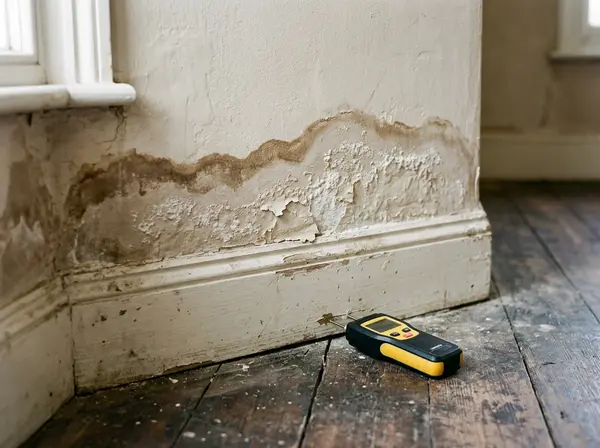
Help walls dry out, without chemicals
A tide mark, salts or crumbling plaster low on a wall are classic signs of rising damp. Every rising damp job we have fitted so far has dried out and stayed dry, with the vents doing the work on their own.
Fitted from outside in the mortar joints along the base of the affected wall, about every 450mm for mild cases or in every perpend (about 225mm) for most, they use the wind to pull moist air out of the wall. No injected chemicals, no drilling inside, no wiring and no running costs. Fit them once; after that it is a quick check now and then, made easy by the removable insert.
It works on two fronts. Cross-ventilation dries the wall, and it lowers the humidity in the cavity. That second part matters: water sitting on the damp-proof course, a tray or a lintel evaporates, condenses on cold surfaces such as the inner wall, wall ties and insulation (interstitial condensation), then runs back down and starts the cycle again. Lower the humidity and you break that cycle, which is exactly what Active Vent is designed to do.
It is still worth checking for soil or a path built up above the damp-proof course, as clearing it helps the wall dry faster.
Monitored trials now under way
We are fitting vents in homes with damp and logging moisture and humidity with sensors, alongside thermal camera readings of the wall temperature. We will publish the results here.
Dry walls hold heat better
Wet insulation lets heat through far faster than dry. In a laboratory study, rock wool at 5% moisture by weight conducted up to about 94% more heat than when dry. Keeping the cavity dry helps insulation perform closer to its rated value. We have not yet measured how much Active Vent changes heat loss, so we do not quote a saving; the finder includes a "what if" scenario you can try with your own figures.
- ›No electricity to run: powered by the wind, with no motor and no running costs.
- ›Made in South Wales: manufactured in Cardiff and sent out from our base in Swansea, about 30 minutes apart, which keeps transport miles low.
- ›Recycled option: Recycled Black is 100% recycled polypropylene, at no extra cost.
- ›Kept in service: the removable insert means a vent can be checked and cleared rather than cut out and replaced.

Heat let through by insulation, compared with dry
Guidance for your situation
Homeowner
Damp, condensation or mould at home
Landlord or housing provider
One home or a whole portfolio
Builder, developer or trade
New build, repair work or supply
Surveyor, inspector or insurer
Evidence, inspection and risk
Energy and green building
Heat loss, carbon and materials
Damp and ventilation, answered
What causes damp in a house?
Most damp comes from moist air or water with no way out. Indoors, cooking, washing and breathing add water vapour that condenses on cold surfaces. In cavity walls, wind-driven rain gets in through small cracks and joints and is trapped if it cannot drain and dry. Ground moisture rising into the base of a wall (rising damp) is another. Leaking roofs, gutters and plumbing need repairing at the source.
What is cross-ventilation, and why does it matter?
Cross-ventilation needs an inlet and an outlet, so air flows through and carries moisture away. A vent that only lets air in, or a fan that only pushes air out, soon stalls. Each Active Vent breathes in and out from one unit, powered by the wind, so it does not depend on doors or windows being left open.
Which Active Vent product do I need?
For damp in walls, damp after rain, blocked weep vents or rising damp: the Active Weep Vent, fitted in the outside wall. For condensation on windows and mould in rooms: the Active Trickle Vent, fitted in window and door frames. Many homes benefit from both, so the wall and the rooms can each breathe.
Do Active Vents use electricity?
No. They are powered by the wind, with no motor, wiring or running costs. With no wind they work like a standard vent; once the wind picks up, they ventilate actively. The stronger the wind, the stronger the suction.
Do Active Vents help landlords with Awaab's Law?
Active Vent is designed to tackle a common root cause of damp and mould, helping landlords meet their duty to fix the cause and stop it coming back. Awaab's Law sets timescales for social landlords in England to investigate and act on damp and mould hazards; our Awaab's Law hub explains the rules and has a free case tracker.
Can damp walls increase heating bills?
They can. In a laboratory study, rock wool insulation at 5% moisture by weight conducted up to about 94% more heat than when dry (Hayrullin et al., 2022). We have not yet measured how much Active Vent changes heat loss, so we do not quote a saving.
Sources
Every figure on this page, where it comes from, and when we last checked it.
- Approved Document C, para 5.5(c) and Diagram 9b: weep holes every 900mm along a damp-proof tray, and at least two weep holes above an opening. Read the source
- NHBC Standards, chapter 6.1: weep holes over openings no more than 450mm apart, with at least two per opening. Read the source
- Approved Document F, Volume 1 (2021), Appendix B, para B11 and Table B3: indoor relative humidity below 65% as a one-month moving average (new dwellings). Read the source
- WHO Guidelines for Indoor Air Quality: Dampness and Mould (2009). Read the source
- Increase in thermal conductivity of rock wool at 5% moisture by weight, compared with dry (laboratory test). A study of insulation in general, not of Active Vent. Hayrullin, Haibullina and Sinyavin, Transportation Research Procedia 63 (2022) (checked 11 October 2026)
- Of 390 failed brick cavity homes surveyed by BRE, 79 (20%) failed because rubble at the base of the cavity stopped water escaping. BRE's 2015 survey for Constructing Excellence Wales. BRE for BEIS (Research Paper 2021/017), Waterproofing cavity walls to allow insulation in exposed areas, Appendix A, Table 11 (checked 11 October 2026)
- DPCs and cavity trays account for almost half of all superstructure defects; missing weep vents are among the issues listed. NHBC, Technical Extra, Issue 18 (July 2015) (checked 11 October 2026)
- Homes in England with damp problems in 2024 (5% of dwellings). MHCLG, English Housing Survey 2024 to 2025: headline report (checked 11 October 2026)
- GB average gas unit rate, Direct Debit, 1 October to 31 December 2026, including 5% VAT: 7.97 p/kWh. Ofgem, Energy price cap: standing charges and unit rates by region (checked 11 October 2026)
- Typical domestic consumption value (TDCV) for gas, used by Ofgem from 1 July 2026: 9500 kWh/year. Covers all gas use in a typical home, including hot water and cooking, not just space heating. Ofgem, Summary of changes to energy price cap 1 July to 30 September 2026 (revised 2026 TDCV) (checked 11 October 2026)
- Share of all heat lost through the walls in an uninsulated home. Measured for uninsulated homes. In an insulated home the share is different, so treat this as a starting point you can change. Energy Saving Trust, Cavity wall insulation (checked 11 October 2026)
- Natural gas, kWh (gross CV), Scope 1 (direct emissions from burning the gas): 0.18231 kg CO₂e/kWh. DESNZ, Greenhouse gas reporting: conversion factors 2026 (checked 11 October 2026)
Prices come from our shop and may change; see the shop for the latest. Results depend on the property, its condition and exposure, how it is heated and used, and the weather. See our data and claims disclaimer.
Ready when you are
Pre-order online with free UK mainland delivery from £50, or talk to us about your home or portfolio.